Wednesday, September 14, 2011

"With the sextant he made obeisance to the sun-god..."

With the sextant he made obeisance to the sun-god, he consulted ancient tomes and tables of magic characters, muttered prayers in a strange tongue that sounded like Indexerrorparallaxrefraction, made cabalistic signs on paper, added and carried one, and then, on a piece of holy script called the Grail - I mean, the Chart - he placed his finger on a certain space conspicuous for its blankness and said, "Here we are." When we looked at the blank space and asked, "And where is that?" he answered in the cipher-code of the higher priesthood, "31 -15 - 47 north, 133 - 5 - 30 west." And we said, "Oh," and felt mighty small.

Jack London, The Cruise of the Snark

A sextant is an instrument used to measure the angle between any two visible objects. Its primary use is to determine the angle between a celestial object and the horizon which is known as the altitude. Making this measurement is known as sighting the object, shooting the object, or taking a sight and it is an essential part of celestial navigation. The angle, and the time when it was measured, can be used to calculate a position line on a nautical or aeronautical chart. A common use of the sextant is to sight the sun at solar noon and to measure the elevation (altitude) angle at night to measure the elevation angle from the horizon plane to Polaris to find one's latitude. Since the sextant can be used to measure the angle between any two objects, it can be held horizontally to measure the angle between any two landmarks which will allow for calculation of a position on a chart. A sextant can also be used to measure the Lunar distance between the moon and another celestial object (e.g., star, planet) in order to determine Greenwich time which is important because it can then be used to determine the longitude.

Tuesday, September 13, 2011

"I sighted South with the Theodolite"

A theodolite (play /θiːˈɒdəlaɪt/) is a precision instrument for measuring angles in the horizontal and vertical planes. Theodolites are mainly used for surveying applications, and have been adapted for specialized purposes in fields like meteorology and rocket launch technology. A modern theodolite consists of a movable telescope mounted within two perpendicular axes — the horizontal or trunnion axis, and the vertical axis. When the telescope is pointed at a target object, the angle of each of these axes can be measured with great precision, typically to seconds of arc.

Closer to home....A familiar sight in Michigan at the Clare Welcome Center. Although the metal sculptures are not Anarctic exploreres the background of the sculptures does have a history.

 The sprawling interpretation of a road construction crew is actually a tribute to highway workers who have lost their lives on the job. The memorial was conceived and paid for by MDOT employees and retirees, and created by artist Carl Floyd using metal salvaged from highway jobs. It was installed in 1994.


Monday, September 12, 2011

"It is Not Gaudy, It's Italianate"

1840 - 1885: Italianate House Style

Italianate became the most popular housing style in Victorian America. Italianate is also known as the Tuscan, the Lombard, or simply, the bracketed style.

Victorian Italianate style house in Cape May, New Jersey

Victorian Italianate style house in Cape May, New Jersey

Photo © Jupiterimages Corporation
Italianate houses have many of these features:
  • Low-pitched or flat roof
  • Balanced, symmetrical rectangular shape
  • Tall appearance, with 2, 3, or 4 stories
  • Wide, overhanging eaves with brackets and cornices
  • Square cupola
  • Porch topped with balustraded balconies
  • Tall, narrow, double-paned windows with hood moldings
  • Side bay window
  • Heavily molded double doors
  • Roman or segmented arches above windows and doors
About the Italianate Style:

The Italianate style began in England with the picturesque movement of the 1840s. For the previous 200 years, English homes tended to be formal and classical in style. With the picturesque, movement, however, builders began to design fanciful recreations of Italian Renaissance villas. When the Italianate style moved to the United States, it was reinterpreted again to create a uniquely American style.

By the late 1860s, Italianate was the most popular house style in the United States. Historians say that Italianate became the favored style for two reasons:

  • Italianate homes could be constructed with many different building materials, and the style could be adapted to modest budgets.
  • New technologies of the Victorian era made it possible to quickly and affordably produce cast-iron and press-metal decorations.

Saturday, September 10, 2011

You Never Know Until you Do the Research!

Kathleen: "I've a theory that all social events fall under one of two broad categories; balloon ascensions and bear baiting. According to their pretensions, of course. Last evening was a bear-baiting posing as a balloon ascension."
BEARBAITING, the medieval sport of setting of dogs on a bear or a bull chained to a stake by the neck or leg. Bears would often also be blinded. Popular from the 12th to the 19th century, when they were banned as inhumane, these spectacles were usually staged at theatre-like arenas known as bear gardens. In England many large groups of bears were kept expressly for this most barbaric and obscene purpose. Contemporary records reveal, for example, that 13 bears were provided for an entertainment attended by Queen Elizabeth I in 1575.

Tuesday, September 6, 2011

Happy Feet?


On June 27, 1911, Wilson and “Birdie” Bowers embarked, with Apsley Cherry-Garrard, on what Wilson described as “the weirdest bird’s-nesting expedition that has ever been or ever will be”. It was a painful, five-week odyssey, the best example of the lengths to which Scott’s men would go purely in the name of science. Scott called it “one of the most gallant stories in Polar history”.

“Why should three sane and common-sense explorers be sledging away on a winter’s night to a Cape which has only been visited before in daylight, and then with very great difficulty?” asked Cherry-Garrard in his book The Worst Journey in the World. Because the Emperor penguin – which was six feet tall, never stepped on land, laid its eggs on ice during the winter, rested the eggs on its feet and pressed them to its abdomen for incubation – was “probably the most primitive bird in the world”.

After three weeks, during which they were sometimes unable to travel more than a mile a day, and the temperature could descend to -75F, they found the birds. “We were witnessing a marvel of the natural world, and we were the first and only men who had ever done so,” enthused Cherry-Garrard. “We had within our grasp material which might prove of the utmost importance to science; we were turning theories into facts with every observation we made.” Men had seen the Emperors before but never with their eggs; and they had never collected undamaged eggs containing embryos. Wilson believed they might reveal the missing evolutionary link between dinosaurs and birds – he was wrong, but the surviving eggs and embryos remain much asked-for treasures of the Natural History Museum.

Captain Scott may have failed to become the first to reach the Pole – but for his contributions to science, he will be remembered for ever.


BACK TO THE POLE?


Happy Feet, Lost Emperor Penguin, Swims for Antarctic Home. Follow the journey!


video platformvideo managementvideo solutionsvideo playe


Friday, September 2, 2011

Early 1911

4 February 1911
  • Corner Camp is established by the depot laying party, 40 miles from Hut Point
The team later lay One Ton Depot at 79° 29' S, more than 30 miles north of its
original intended location

9 February 1911
  • Victor Campbell's Eastern party becomes the "Northern Party" and sets sail

17 February 1911
  • The Northern Party arrives at Robertson Bay and builds a hut close to the
Norwegian explorer, Carstens Borchgrevink’s old quarters, for the 1911 winter

2 March 1911
  • The Western Geological party starts for home taking a southerly route


14 March 1911
  • The Western Geological party arrives back at Hut Point
6 June 1911
  • A feast is arranged to mark Scott's 43rd birthday

21 June 1911
  • A second celebration to mark Midwinter Day, the Antarctic equivalent of Christmas, is held

Monday, August 29, 2011

Paying His Way


Through lectures, sponsorships, private donations and other fundraising efforts Scott and his team were able to raise the funds needed for the Terra Nova Expedition. There were some creative advertising tie-ins as well.

Wolsey Underwear used this image in their ads with the headline "Wolsey Chosen By Scott & Amundsen"

Advertisement for Shell Motor Spirit. Scott experimented with motor sledges. The image implies that Shell is in the forefront of modern technology.


OXO the kitchen utensil supplier also came on board with their advertising.


Cigarette Trading Cards became quite popular as well.

Saturday, August 27, 2011

Stores on Board


To give you an idea of the enormous amount of supplies that were put into store on the Terra Nova here is a detailed and partial list of food brought on board. This does not include the cooking equipment, medical supplies, surveying equipment, scientific supplies, clothing, tents, blankets etc.

Meats-

Brawn ... .., .., ... 100 2-lb. tins.
Bacon rations ... ... 200Ibs.
Potted Meals........1200 4 oz tins
Ham Loaf.. . ... ... 200 1-lb. tins.
Beef Loaf ... ... . . 200 1-lb. tins.
Assorted Potted Mcats ... ...200 4-oz. tins.

Fish
Sardines ... a . e . , . 15 cases 18-oz. tins.
Cod Roe... 200 tins.
Salmon ... ... 230 tins.
Pilcherds in Oil ... ... 500 lbs. (Is.).
Anchovics ... ... ... 129 doz. 1-lb. bottlcs.
Anchovy Paste ... ... ... 12& doz. qts.
Bloater Paste ... 20 doz. qts

Soups............200 2 lb tins
Scotch Broth
Cock-a-leekie
Ox Tail
Mock Turtle
Giblet
Hare

In addition-
2 Tons of Vegetables and dried vegetables
397 tons of Cereals
2 tons of Jams
2 tons of Boiled Fruit and Dried Fruit
2 tons Milk, butter, Cheese,
Pickles and Sauces
2 1/2 tons of Sugar
Cocoa and Chocolate
Tea, Coffee,
Spices
Wines, Spirits, Lime Juices
Tobacco

A neat stack of seal meat sits in an enclosed porch, tins of cocoa and cabbage are piled on shelves inside, and all seems ready for Antarctic explorers Robert Falcon Scott and Ernest Shackleton to take shelter.

Prefabricated in New Zealand in 1910, transported by ship and reassembled on a spit of land on McMurdo Sound in January 1911, the hut was built for the final expedition led by Britain's Scott, whose ill-fated race to reach the South Pole has become the stuff of legend.

It was the biggest structure in Antarctica when it was first built, some 50 feet (15 metres) by 25 feet (7.5 metres), with doors insulated with seaweed and lined with felt. The 52 officers and crew depended on the hut for shelter and for a semblance of civilization: there were clotheslines, clocks and a gramophone.


Wednesday, August 24, 2011

Early 1911


1911

Terra Nova arrives off Ross Island and scouts for possible landing sites - eventually proceeding to the "Skuary" about 15 miles north of Scott’s 1902
Discovery Expedition base. He renames it Cape Evans The shore parties disembark with the ponies, dogs, motorised sledges and the bulk of the party's supplies

18 January 1911

A prefabricated accommodation hut is made

26 January 1911

Griffith Taylor, Debenham, Wright and P.O. Evans land from Terra Nova at
Butter Point for a geological exploration of the west coast of McMurdo Sound

Depot laying on the Barrier for use on the polar journey begins

30 January 1911

The ‘Western Geological’ party establishes its main depot in the Ferrar Glacier
Region and conducts explorations and survey work in the Dry Valley, Taylor
Glacier and Koettlitz Glacier areas

26 January 1911

A party under Campbell heads east but fails to land on King Edward VII Land. Campbell sails north-west to Victoria Land instead. On its return, Terra Nova encounters Amundsen’s expedition camped in the Bay of Whales

Tuesday, August 23, 2011

Terra Nova Timeline 1910


1910

15 June 1910

  • Terra Nova sets sail from Cardiff, Wales.
  • Scott joins the ship later in South Africa and stays on it until it reaches Melbourne, Australia
  • He leaves the ship again to continue fundraising, but not after he receives a telegram from Roald Amundsen to tell him that he too is “proceeding south”
  • Terra Nova proceeds to New Zealand

29 November 1910

  • Terra Nova leaves Port Chalmers, New Zealand. Scott is once again on board – Along with 34 dogs, 19 Siberian ponies and three motorized sledges. However, 2 ponies,1 dog, 1 sledge, coal and petrol are lost a few days later in a heavy storm

10 December 1910

  • Terra Nova meets the southern pack ice and is halted for 20 days before being able to continue south

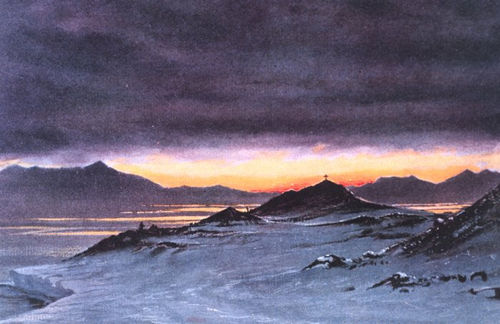
(Painting above based on Edmund Wilson's sketches)


Sunday, August 21, 2011

The Discovery Expedition

Robert Scott had already made an earlier expedition to the South Pole before heading up the Terra Nova Expedition. It launched the Antarctic careers of many who would become leading figures in the Heroic Age of Antarctic Exploration, including Robert Falcon Scott who led the expedition, Ernest Shackleton, Edward Wilson, Frank Wild, Tom Crean and William Lashly.

The British National Antarctic Expedition, 1901–04, generally known as the Discovery Expedition, was the first official British exploration of the Antarctic regions since James Clark Ross's voyage sixty years earlier.


Organized on a large scale under a joint committee of the Royal Society and the Royal Geographical Society (RGS), the new expedition aimed to carry out scientific research and geographical exploration in what was then largely an untouched continent.

Its scientific results covered extensive ground in biology, zoology, geology, meteorology and magnetism. There were important geological and zoological discoveries, including those of the snow-free McMurdo Dry Valleys and the Cape Crozier Emperor Penguin colony. In the field of geographical exploration, achievements included the discoveries of King Edward VII Land, and the Polar Plateau via the western mountains route. The expedition did not make a serious attempt on the South Pole, its principal southern journey, only traveling to the Farthest South mark at a reported 82°17'S.

As a trailbreaker for later ventures, the Discovery Expedition was a landmark in British Antarctic exploration history. After its return home it was celebrated as a success, despite having needed an expensive relief mission to free Discovery and its crew from the ice, and later disputes about the quality of some of its scientific records. It has been asserted that the expedition's main failure was its inability to master the techniques of efficient polar travel using skis and dogs a legacy that persisted in British Antarctic expeditions throughout the Heroic Age.

 The routes of the expedition's main journeys are shown by differentiated lines emanating from the base at Hut Point.
Map showing the Discovery Expedition's general field of work, 1902–04. Main journeys: RED line; Southern journey to Farthest South, November 1902 to February 1903. BLACK line; Western journey through Western Mountains to Polar Plateau, October–December 1903. BLUE line; Journeys to message point and Emperor Penguin colony at Cape Crozier, October 1902, September and October 1903.

( from Wikipedia)

Friday, August 12, 2011

To What End?


Amundsen's Singular Focus on Being First

For Amundsen, significance came from being the first to do something. His drive for success was not entirely a matter of ego. To continue to explore he needed to raise money–lots of it–and challenges that were easy or already accomplished by someone else sold no books and garnered little financial support.

His Antarctic team consisted only of men with the skills and training that could help him to achieve his dream to be the first to stand at 90°S. He took no scientists, journalists, or others who might have had their own plans.

For Scott, the significance of this journey was a more complex issue. Being first at the South Pole mattered, but so did science. Because he wanted his expedition to be both a triumph of exploration and an expansion of knowledge, he invited scientists to join him, at significant expense to his program. The observations and collections they made during the course of the Terra Nova expedition formed the basis for an extensive body of scientific literature that is still consulted today.